How Marriage Counseling Improves Communication Between Partners?

Marriage counseling for communication is basically a relationship tune-up. It gives couples the tools to actually talk and actually listen. No more talking past each other. No more going to bed angry every night. Most couples feel a real difference within 8 to 12 sessions. So it works faster than you might think.
In This Article, We Will Cover :
- Why couples lose the ability to communicate
- How counseling fixes communication step by step
- What actually happens inside therapy sessions
- How to get the ball rolling
- Common questions about counseling in Collingswood
Why Do Couples Lose the Ability to Talk to Each Other?
Here is the thing: it never happens overnight. First, stress piles up. Then, small frustrations get swept under the rug. After a while, even a simple conversation can blow up into a full-blown argument.
That is what a communication breakdown looks like. It means partners can no longer share what they need in a way that the other person actually gets. And so the same old fights keep coming back. Round and round, with nothing ever really getting fixed.
According to the American Association for Marriage and Family Therapy, communication problems are the number one reason couples seek therapy.
Sound familiar? Watch out for these signs:
- Conversations go south really quickly
- You feel unheard, no matter how hard you try
- Silence has replaced honest conversation
- Small stuff starts to feel like a big deal
- Resentment is quietly building up under the surface
But here is the kicker – the argument you are having on the surface is rarely the real problem. Underneath, there is usually old hurt, fear of being rejected, or habits picked up from two very different upbringings. That is exactly what relationship counseling helps you dig into, and actually deal with.
How Does Marriage Counseling Actually Fix Communication?
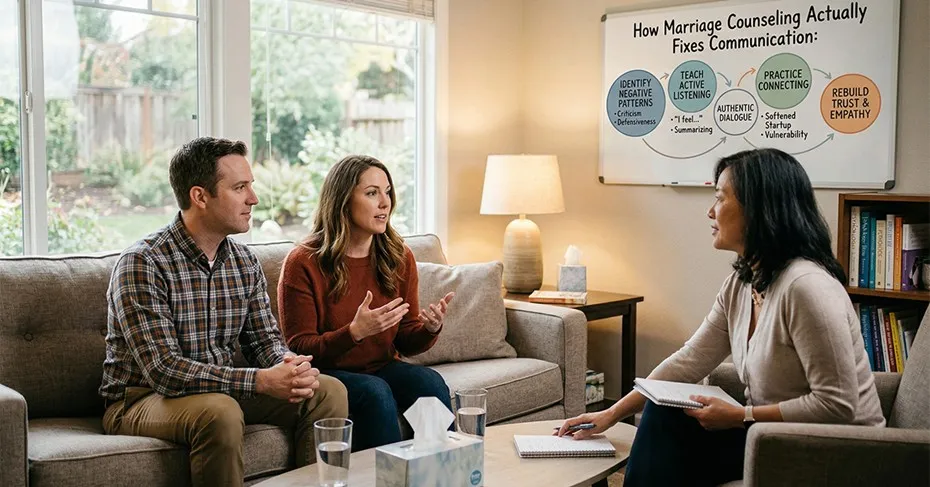
Let us get one thing straight: counseling does not just tell couples to “talk more.” It teaches them how to talk better. Big difference.
A therapist gets to the root of what is hurting your communication. Then they hand you practical tools to replace old, broken habits with healthier ones. So what does that actually look like? Here is a breakdown.
Learning to Actually Hear Each Other
Most people listen while already cooking up what to say next. Sound familiar? That habit quietly kills honest conversation. Eventually, it pushes couples miles apart.
Counseling helps partners slow down and genuinely hear each other out. Once that clicks, defensiveness drops. Your partner finally feels understood. And just like that, the whole vibe of the conversation changes.
Saying What You Feel – Without Starting a War
Here is the truth: a lot of people never learned to put their emotions into words. That is where therapists step in. They use simple tools like “I” statements to help partners express themselves without throwing punches. So instead of snapping “You never listen to me,” you learn to say “I feel dismissed when I am interrupted.”
Same message. Way better outcome.
Pumping the Brakes Before Things Explode
Arguments can go from zero to nuclear in no time flat. But here is the good news: counseling teaches you to catch the early warning signs. Things like a raised tone, crossed arms, or complete shutdown.
From there, you learn to pump the brakes before things spiral. Step back. Breathe. Then re-engage calmly instead of blowing up or going cold.
Breaking Free From the Same Old Cycle
Most couples are stuck on a hamster wheel. One partner reacts. The other reacts to that reaction. And off they go again. Spotting this cycle and jumping off it is at the heart of lasting communication change.
Approaches like Emotionally Focused Therapy (EFT) and the Gottman Method are built on exactly this idea. Both agree that communication skills only stick when partners feel emotionally safe. So building that safety always comes first.
What Techniques Do Therapists Actually Use?
| Technique | What It Does | Best For |
|---|---|---|
| Emotionally Focused Therapy (EFT) | Digs into the deeper needs behind conflict | Emotional distance |
| Gottman Method | Builds friendship and dials down conflict | Recurring arguments |
| Cognitive Behavioral Therapy (CBT) | Rewires thought patterns that trigger reactions | Anxiety-driven conflict |
| Narrative Therapy | Helps couples rewrite their shared story | Overcoming old resentment |
| Imago Relationship Therapy | Connects childhood baggage to current habits | Couples stuck in old patterns |
For most couples, EFT and the Gottman Method hit the nail on the head. That said, if anxiety or depression is in the mix, CBT might be a better jumping-off point. Either way, a good therapist will steer you in the right direction.
According to the American Psychological Association, couples therapy has a success rate of around 70%. And communication? That is the area that improves most consistently across the board.
How to Get the Ball Rolling With Marriage Counseling?
Step 1: Agree that it is a shared problem
Both partners need to walk in as a team. Counseling is not a place to prove who is right. Drop that idea at the door — it makes all the difference.
Step 2: Write down what you want to change
Before your first session, each partner jots down two or three habits they want to work on. Give your therapist something real to work with.
Step 3: Find the right therapist
Look for a licensed marriage and family therapist (LMFT) or a licensed professional counselor (LPC). If getting to an office feels like a stretch, virtual marriage counseling services in Collingswood let you get solid help right from your couch.
Step 4: Come clean in your first session
Your therapist will ask about your history and your goals. No need to put on a show. Just tell it like it is, that is where real progress begins.
Step 5: Put in the work between sessions
Here is the deal: change happens in daily life, not just in the therapy chair. Your therapist will give you simple exercises to practice every day. Short conversations, journaling, or a quick pause-and-reconnect technique.
Step 6: Take stock at four to six weeks
Most couples notice real shifts within two months. So check in honestly with your therapist. Talk about what is clicking and what is not. Then tweak the plan as you go.
FAQs
Q1: How long before we start seeing results?
Most couples notice a difference within 4 to 8 sessions. However, lasting change tends to take about 3 to 6 months of regular work. The timeline really depends on how deep the issues go and how much both partners practice outside of sessions.
Q2: Can we do couples counseling in Collingswood with conflicting work schedules?
Absolutely. Couples counseling in Collingswood offers flexible hours, including evenings and weekends. On top of that, many therapists offer virtual marriage counseling services in Collingswood. So both partners can attend from wherever they are, no commute needed.
Q3: What if only one of us is on board?
Ideally, both partners attend. But if your partner is not ready yet, individual therapy focused on relationship patterns can still move the needle. In fact, one partner starting therapy often convinces the other to give it a shot eventually.
Q4: Is marriage counseling only for couples on the edge?
Not at all. Waiting until everything hits rock bottom is honestly one of the biggest mistakes couples make. Marriage counseling in Collingswood works just as well as a proactive step. Plenty of solid couples use it to stay tight and sort out smaller issues before they snowball.
Q5: Is virtual marriage counseling as well as in-person?
In a word, yes. Research shows comparable results for most couples. Sessions run the same way, just over a secure video call. For couples juggling busy schedules, young kids, or limited transport, virtual counseling is a no-brainer.
Here Is the Bottom Line
Good communication is not some rare gift that only lucky couples are born with. It is a skill. And like any skill, you can learn it, practice it, and get better at it, as long as you have the right support in your corner.
Marriage counseling gives you the structure, the tools, and the push to make real change happen. Whether you are stuck in the same old fights, feeling miles apart, or simply want to feel close again, help is right around the corner. Browse our resources and services today. Find the right support for where you are right now.