
What to Expect in Your First Individual Counseling Session & How to Prepare?

Your first session for individual counseling services is basically a get-to-know-you conversation. Your therapist asks questions. You share what brought you in. Together, you figure out if it feels like a good fit. That is it. No pressure to have everything figured out on day one.
In This Article, We Will Cover :
- What actually happens in your first session
- How to prepare so you feel ready, not rattled
- What your therapist will ask you
- How to know if your therapist is the right one
- Common questions first-timers always ask
Is It Normal to Feel Nervous Before Your First Session?
Most people feel a little on edge before that first appointment. Some feel downright terrified. You are about to open up to a stranger, after all. That is a big deal. But here is the thing: nervousness almost always fades. Once you sit down, hear a calm voice, and realize no one is judging you, the walls come down pretty quickly.
And if nerves do not go away after a few sessions? That is worth mentioning to your therapist. They can help you work through it directly. So if your stomach is doing flips right now, you are totally normal.

What Actually Happens in Your First Individual Counseling Session?

Your first session is not about fixing everything at once. Think of it more like an intake meeting. Your therapist wants to understand who you are, what brought you in, and what you hope to get out of therapy. That is the whole goal of session one. Here is a rough idea of how it usually plays out:
You Fill Out Some Paperwork First
Most practices send forms ahead of time. Some ask you to fill them out in the waiting room. These forms cover basic stuff, your contact info, medical history, what you are struggling with, and insurance details. Nothing too intense. Just the groundwork.
Your Therapist Breaks the Ice
Once you are in the room, your therapist usually kicks things off with something simple. Something like, “So, what brings you in today?” No trick questions. No deep dives right out of the gate. Just a warm, open invitation to start talking at your own pace.
You Share Your Story – As Much as You Are Comfortable With
You do not have to spill everything in one go. Seriously. Your therapist will ask about what is going on in your life, how long things have felt this way, and a bit about your background. Think of it as painting a picture, broad strokes first, details later.
According to Psychology Today, first sessions focus on your general story, what brought you to therapy, and what you hope to achieve — not on solving problems right away.
Your Therapist Explains Their Approach
Toward the end of the session, your therapist will usually walk you through how they work. They might explain their therapy style, whether that is talk therapy, Cognitive Behavioral Therapy (CBT), or something else. They will also give you a sense of what sessions going forward might look like. This is also a good time to ask questions.
You Both Figure Out If It Is a Good Fit
Here is something a lot of first-timers do not realize: you are interviewing them just as much as they are getting to know you. If something feels off, that is useful information. A good therapist will actually encourage you to be honest about that.
How Do You Prepare for Your First Individual Counseling Session?
A little prep goes a long way. You do not need to show up with a polished speech. But going in with a rough idea of what you want to say makes a real difference.
Here is how to get your ducks in a row before the big day.
Step 1: Think About Why You Are Going
Ask yourself, what is the main thing I want to talk about?
You do not need a perfectly worded answer. Just a general sense of what has been weighing on you. Is it anxiety? A relationship falling apart? Feeling stuck in life? Burnout? Write it down if that helps.
Step 2: Jot Down a Few Key Points
Think about what your therapist should know upfront. Maybe there is something from your past that feels relevant. Maybe you have tried therapy before, and it did not click. Maybe you are on medication. Whatever feels important, bring it up. Your therapist can handle it.
Step 3: Know What You Hope to Get Out of It
You do not need a five-year plan. But having even a rough goal helps. It could be as simple as, “I want to stop feeling so anxious all the time,” or “I want to actually deal with this instead of bottling it up.” That is enough to work with.
Step 4: Sort Out the Logistics Ahead of Time
Nothing cranks up stress like being lost five minutes before your appointment. If it is somewhere new, look up the route the night before. Plan to arrive a few minutes early. Bring your insurance card and any forms the office sent you. Small stuff, but it makes you feel way more in control walking through the door.
Step 5: Manage Your Expectations Going In
Here is the truth: you probably will not feel completely better after session one. And that is totally fine. The first session is about laying the groundwork. Progress comes with time. Going in with realistic expectations means you will not walk out feeling disappointed.
What Will Your Therapist Ask You?
Good question, and one most people wonder about on the way there.
Your therapist is not going to fire rapid questions at you like an interrogation. Instead, think of it as a slow, guided conversation. Here are the kinds of things they will typically ask:
- “What brought you in today?”
- “How long have you been feeling this way?”
- “Have you been to therapy before? How did that go?”
- “What does your day-to-day life look like?”
- “What would you like to be different after working together?”
They may also ask about your family background and mental health history. Not every therapist does this in session one — but many do, since family history can offer useful context.
The key thing to remember? There are no wrong answers. Your therapist is not grading you.
How Do You Know If Your Therapist Is the Right Fit?
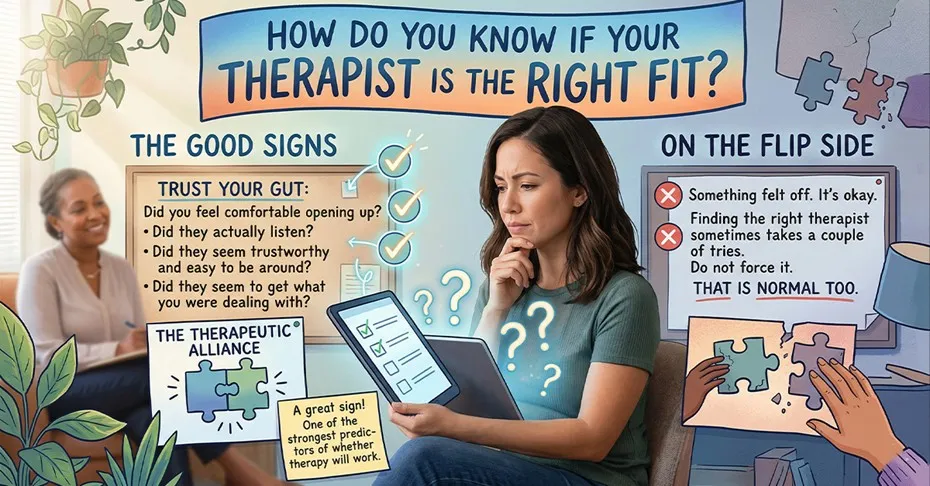
Trust your gut on this one. After the session, ask yourself a few honest questions:
- Did you feel comfortable enough to open up?
- Did they actually listen, or did it feel like they were just waiting to talk?
- Did they seem trustworthy and easy to be around?
- Did they seem to get what you were dealing with?
If most of your answers lean toward yes, that is a great sign. That connection between you and your therapist, what experts call the therapeutic alliance, is actually one of the strongest predictors of whether therapy will work.
On the flip side, if something felt off, do not force it. Finding the right therapist sometimes takes a couple of tries. That is normal too.
What About Online or Virtual Sessions?
Virtual therapy works pretty much the same way as in-person, especially for that first session. Your therapist will still ask the same questions. The vibe is still the same warm, low-pressure conversation. The only real difference is the screen between you.
A few things to keep in mind, though:
- Find a private, quiet spot where you will not be interrupted
- Test your camera and audio beforehand; tech hiccups mid-session are no fun
- Your therapist may ask for your location in case of an emergency
Other than that? You are good to go from your couch, your car, or wherever feels most comfortable.
FAQs
Q1: What should I say in my first individual counseling session?
Just start with what brought you in. You do not need a polished speech. Your therapist will ask questions to guide the conversation, so you do not have to have it all figured out before you walk in. Honest and simple beats perfect every time.
Q2: Do therapists offer free first sessions?
Many therapists offer a free phone consultation before your first paid session. Some also offer a free in-person intro meeting. However, not all do, so it is worth checking with your therapist before booking. Either way, confirm your insurance coverage and any co-pay details ahead of time.
Q3: Is it okay to cry during the first session?
Absolutely. Therapists are trained to handle big emotions, which is literally their job. If you start crying, they will respond with calm and zero judgment. And if you feel embarrassed about it, that is actually something worth exploring together. It can open up a really productive conversation.
Q4: Can I bring someone to my first therapy session?
You can bring a friend or family member to sit in the waiting room for moral support, no problem at all. Having someone actually sit in on your individual session is a different matter, though. Most therapists keep one-on-one therapy private. If this matters to you, ask your therapist beforehand and see where they stand.
Q5: What if I do not feel better after my first session?
That is completely expected. Session one is about getting to know each other and laying the groundwork, not instant relief. Most people start noticing real shifts after several sessions of consistent work. Give it time and be patient with yourself. The fact that you showed up at all? That is already a huge step forward.
Q6: Do I pay before or after the session?
It depends on the therapist. Many prefer payment up front or at the start of the session. Some ask for a card on file. If your therapist does not bring it up, just ask. Getting the money side sorted early means you can focus fully on the actual work.
You Have Already Taken the Hardest Step
Here is the bottom line: deciding to go to therapy is honestly the toughest part. Everything after that is just showing up and being real. You do not need to have it all together. You do not need the perfect words.
You just need to walk through the door. Your first individual counseling session is just a conversation. And that conversation can be the start of something that genuinely changes your life. Browse our resources and services today and find the right support for where you are right now.